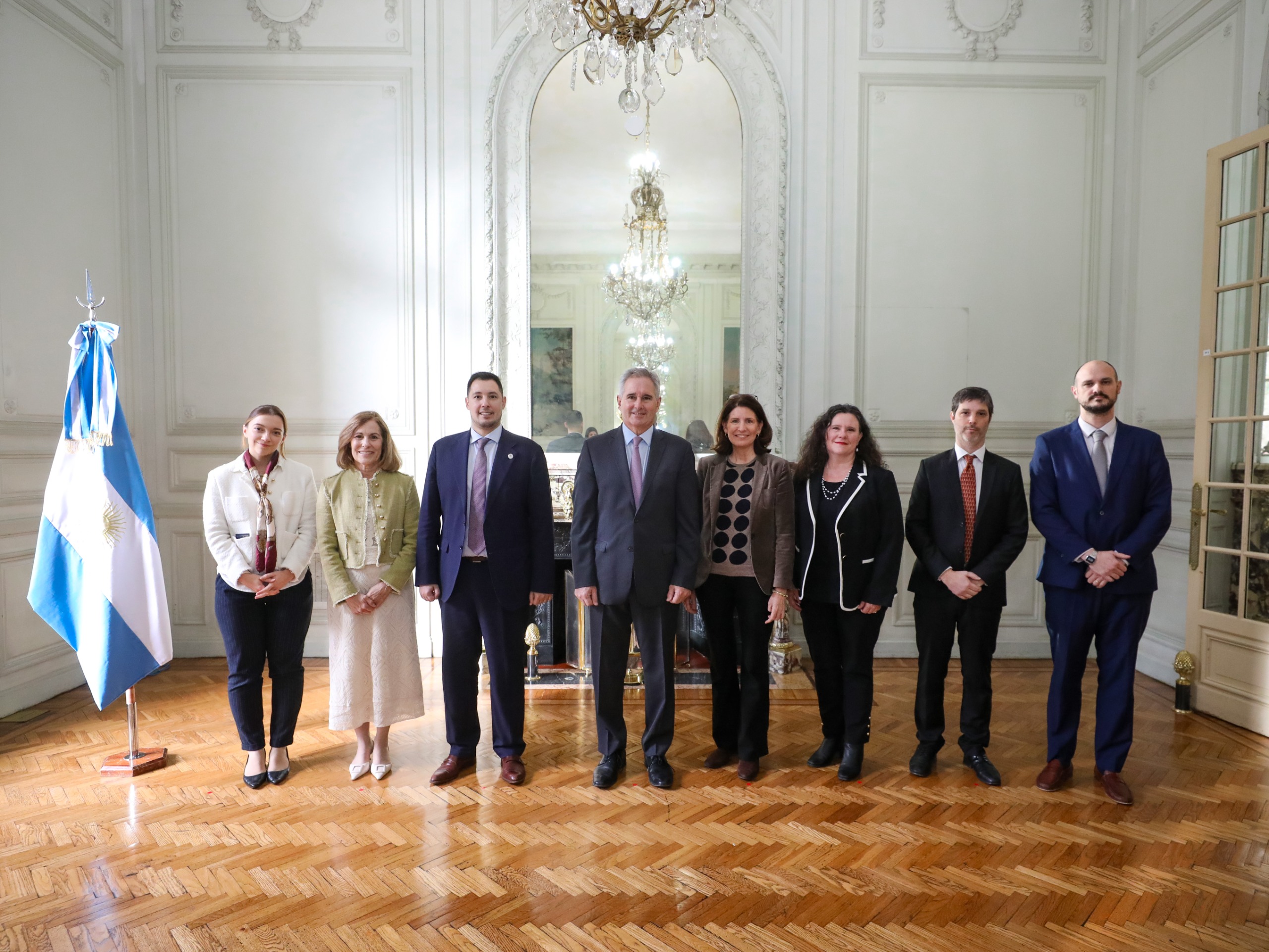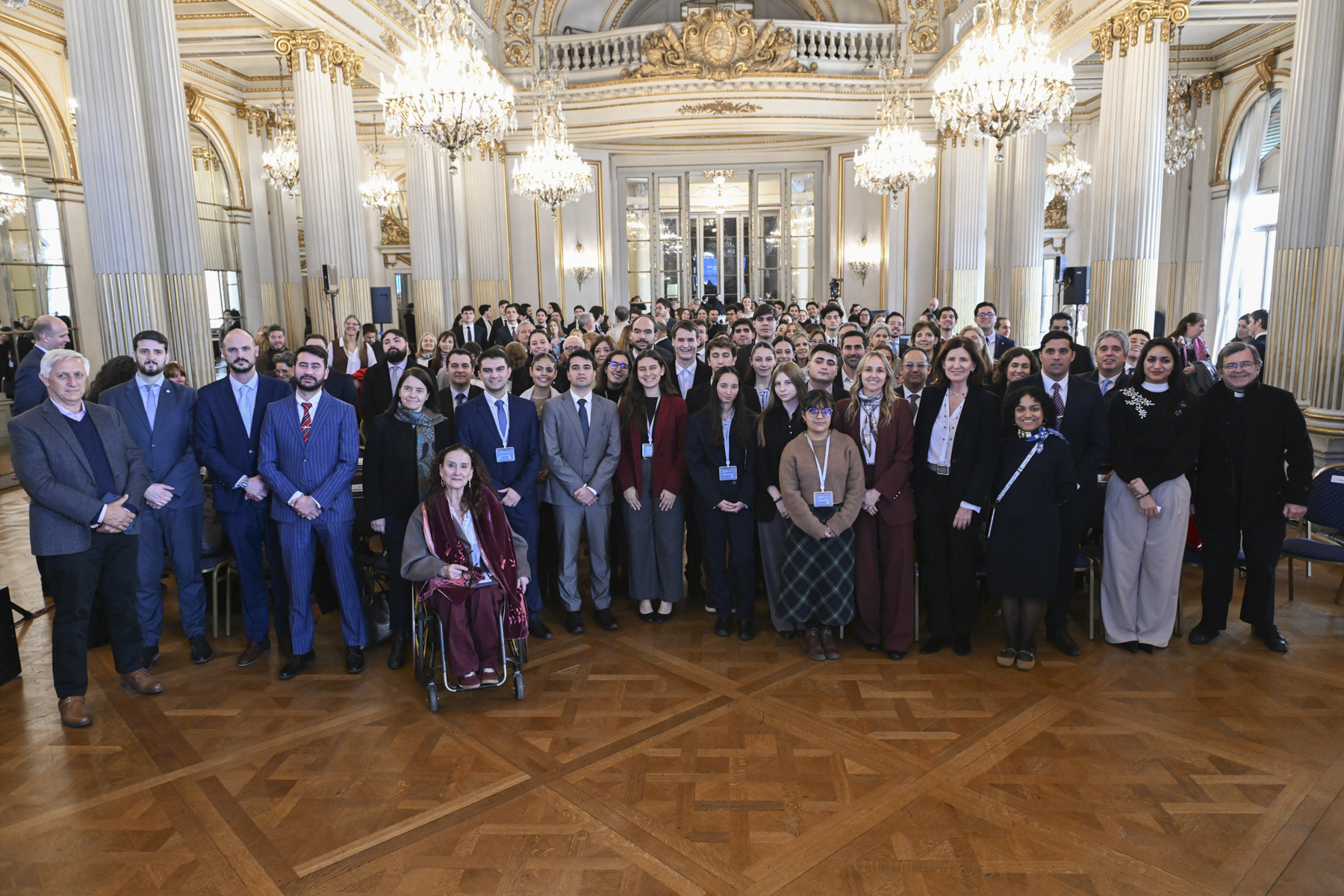
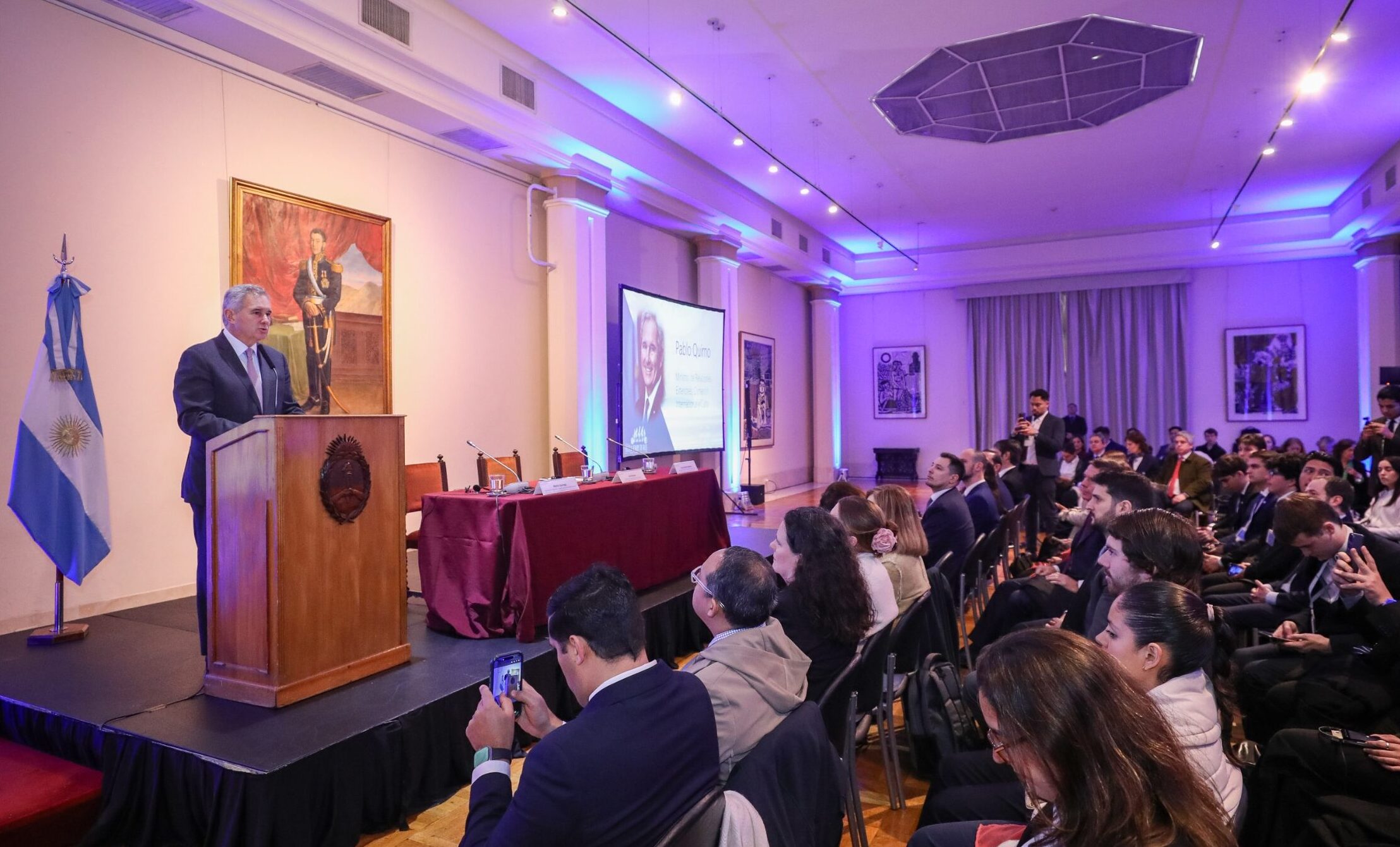
We share the full speech by the Foreign Minister of the Republic of Argentina, Pablo Quirno, at the opening of the Trialogue “Protecting the Future: Natural Rights at the Center of the International Agenda,” held at the San Martín Palace on July 24.
*
Executive Director of Political Network for Values, Ms. Lola Velarde;
President of the Institute for Women’s Health, Ms. Valerie Huber;
National authorities and legislators,
Representatives of civil society organizations,
It is a privilege to welcome you to the San Martín Palace to open this Trialogue. The caliber of those gathered here today reflects the importance of the task before us. This gathering brings together those who make laws, carry out policies, and build institutions. That convergence can turn shared convictions into an agenda capable of protecting freedom and life, while also guiding public life.
Allow me to begin with a definition that has crossed the centuries without losing its relevance. Saint Thomas Aquinas called natural law “the participation of the eternal law in the rational creature.” That formulation captures the truth that brings us together today. A simple truth, yet a profoundly demanding one. The human condition has a foundation that precedes the will of power. Right reason can recognize it. Politics has the responsibility to protect it.
Speaking of natural law does not mean invoking a philosophical abstraction or proposing a doctrine reserved for specialists. It means recognizing that there are truths about the human person that political power does not establish and that, for that very reason, it cannot modify according to the circumstances of any given era. Precisely because these rights precede the State, they also constitute the limit that no authority may cross.
Natural law does not limit freedom. It prevents power from arbitrarily limiting freedom. Life does not acquire value because a majority recognizes it. Freedom does not depend on an administrative concession. Property is not born of the ruler’s will.
That is the difference between a political order founded on the nature of man and one built solely on the will of power. When the State forgets that limit, rights cease to be inherent to the person and begin to depend on whoever happens to hold authority.
This is also the conviction that President Javier Milei chose to place once again at the center of state priorities. The rights that are born with the person order our domestic policy and project our voice into the world. Life, liberty, and private property form a trilogy of moral unity. There lies the foundation of a society in which every individual can pursue their calling, form a family, practice their faith, and build their future.
Life from the moment of conception, liberty, private property, and equality before the law are, for that reason, the moral compass of our Government. In this principle, the State finds both its direction and its limit. True freedom is not born from the absence of limits. It is born from recognizing those rights that naturally belong to every person and that no authority may dispose of at will. Its legitimacy comes from protecting those rights and creating the conditions for every human being to exercise them fully.
That conception changes the way we understand the exercise of power. Governing ceases to mean administering rights granted from above and becomes instead a matter of guaranteeing the free exercise of rights that exist prior to the State itself. That is the idea that sets the direction of the reforms our government is pursuing.
Every public decision must answer an essential question: does it expand a person’s space of freedom, protect their life, respect the fruit of their labor, and strengthen their responsibility? That is the measure of just policy. The economy is not a separate chapter from this vision. It, too, is an expression of natural law. When the State respects freedom, protects property, and guarantees stable rules, it acknowledges that individuals have the capacity to produce, trade, and prosper on their own.
Our economic transformation stems from that same conception. A stable currency protects the fruit of one’s labor. Fiscal balance prevents the State from passing its excesses on to future generations. Legal certainty recognizes that savings, enterprise, and investment belong to those who take risks and create value. Private property occupies a decisive place here. It gives every person a sphere of autonomy, allows them to support a family, and turns present effort into a project for the future. When that right weakens, responsibility, trust, and the capacity to generate wealth deteriorate along with it.
That is why we are opening markets, removing barriers, and seeking predictable rules for investment. Economic freedom expands opportunity and restores dignity to work. For our Government, overcoming poverty is a moral imperative. Prosperity stops being just a number when a family regains a horizon, a young person can plan their life, and a community once again trusts in its own strength. Because a truly free economy does not produce wealth alone. It strengthens people’s autonomy, consolidates families, and expands the spaces of freedom that make an open society possible.
Argentina’s experience shows that permanent truths also produce results. Fiscal order, openness, and respect for private initiative are all part of the same institutional recovery. The values that sustain a free society are pillars for restoring growth, credibility, and hope.
Carlos Sacheri captured this responsibility precisely when he wrote that “natural law must be the foundation of positive law.” That is where the responsibility of those of us who hold public office lies. Positive law attains its highest dignity when it recognizes a justice that precedes it.
Our task is to translate guiding principles into effective institutions, clear rules, and decisions capable of protecting the person in everyday life. Defending life means recognizing the unrepeatable value of every human being from the moment of conception. Defending freedom means affirming that every person has conscience, responsibility, and a calling that power must respect. Defending property means guaranteeing the fruit of one’s labor, a family’s savings, and the concrete possibility of building a future.
These three rights do not compete with one another. They form an indivisible architecture. Life is the precondition of all freedom. Property protects the fruit of that effort and provides the sphere of autonomy essential to sustaining a family, building a venture, and passing on a legacy. When one of these pillars weakens, the entire institutional edifice begins to lose stability.
A Nation’s coherence is also measured in this way. A country that recognizes these principles in its domestic life cannot abandon them when it engages with the world. Foreign policy is never a separate sphere from national life. It is the international expression of a society’s understanding of the human person. For that reason, diplomacy can never be separated from the foundations that organize the Republic.
Nations project onto the world the same idea of the person around which they organize their own institutional life. As Foreign Minister and Minister of Worship, it falls to me to translate this vision into international action and into institutional dialogue with faith communities.
Argentine foreign policy is never neutral when it comes to the conception of the human being. Every position a country adopts reveals what it understands by dignity, what it considers the limit of power to be, and what kind of civilization it is willing to defend. Every vote, every negotiation, and every alliance expresses a hierarchy of values. Argentine diplomacy is once again speaking from a recognizable identity, rooted in the Western tradition and in our Judeo-Christian roots.
That identity guides our conduct in international forums. Argentina promotes the protection of life from conception, recognizes the family as the natural and fundamental unit of society, defends religious freedom and freedom of conscience, and upholds an agenda for women that fully values their dignity and their decisive role in social life. It also upholds the sovereignty of states and the legal equality of all individuals. These are positions consistent with our Constitution, our history, and the mandate this Government received.
The multilateral debate needs to recover its purpose. International bodies gain legitimacy when they preserve peace, facilitate cooperation, and offer concrete solutions. They lose authority when their bureaucracies try to turn ideological preferences into universal obligations. Argentina takes part with its own voice. We examine every initiative in light of the unrepeatable value of life, the freedom of nations, and the results it delivers for real people. Our position demands intellectual courage.
The crisis facing the West did not begin solely in the economic or technological sphere. It began when many societies stopped recognizing the permanent foundations on which they had built their freedom. That is also where much of the debate now running through the international system originates. For years, certain fictitious consensuses displaced essential questions and presented relativism as an inevitable form of progress. Our country decided not to resign itself to that drift. We believe that the strength of a democracy depends on the values on which it chooses to build its institutions.
Argentina is once again asking a basic question. Who protects the person when politics disregards a truth that precedes it? The answer defines the quality of our democracies and also the future of the West.
The cultural battle is also fought in language. Words can illuminate reality or conceal it. A serious public agenda must call life life, freedom freedom, and property property. When vocabulary becomes detached from human nature, legislation loses its bearings and diplomacy becomes subject to the ideological currents of the moment. Restoring the truth of words is also restoring the responsibility of politics.
This conviction explains our defense of the family. There, the person receives care, learns duties, discovers limits, and comes to know the value of giving of oneself. There, a culture is passed on and a nation’s character is formed. A policy that strengthens families builds moral capital, social trust, and stability. A diplomacy that recognizes its importance safeguards the human fabric on which every international community rests.
That same conception of the person guides our defense of religious freedom. Faith is part of the deep identity of millions of citizens and provides a vital source of service, education, and meaning. From the Foreign Ministry, we also promote respectful dialogue with religious communities. God can hold a place in public conversation with serenity, intelligence, and respect for the freedom of every conscience.
This Trialogue therefore has a mission that extends beyond today. It brings together knowledge, political will, and civic leadership to turn a shared vision into the capacity for action. It can bring international experience closer to our institutions and project, from Argentina, a voice that today carries clarity, conviction, and a will to lead.
Humanity has been reflecting on these principles for centuries. Cicero summed them up with a clarity that still speaks to our time: “there will be one law, eternal and unchanging, valid for all peoples and all times.” That universality defines the responsibility of our generation. Power finds its limit in the dignity of the person. Law attains legitimacy when it recognizes what precedes it. International action gains greatness when it brings that truth to the meeting of nations. Argentina has chosen to occupy that place.
From this House, I call on you to turn principles into institutions, convictions into policies, and values into a firm international presence. Argentines are once again recognizing themselves in the ideas that shaped the West and are offering them to the world as a course for governance.
Defending natural law does not mean looking to the past. It means remembering that there are truths capable of guiding the future. Societies that forget their foundations end up endlessly debating what a person’s rights are. Societies that recognize them can devote all their energy to protecting them, passing them on, and helping them flourish. That is where a Nation’s true freedom begins. That is also where its future begins.
The future is protected from its foundations. You can count on this Foreign Ministry and on my personal commitment to project a diplomacy at the service of life, freedom, property, and human dignity.
Thank you very much.
[Unofficial translation. The original speech, in Spanish, can be read here]