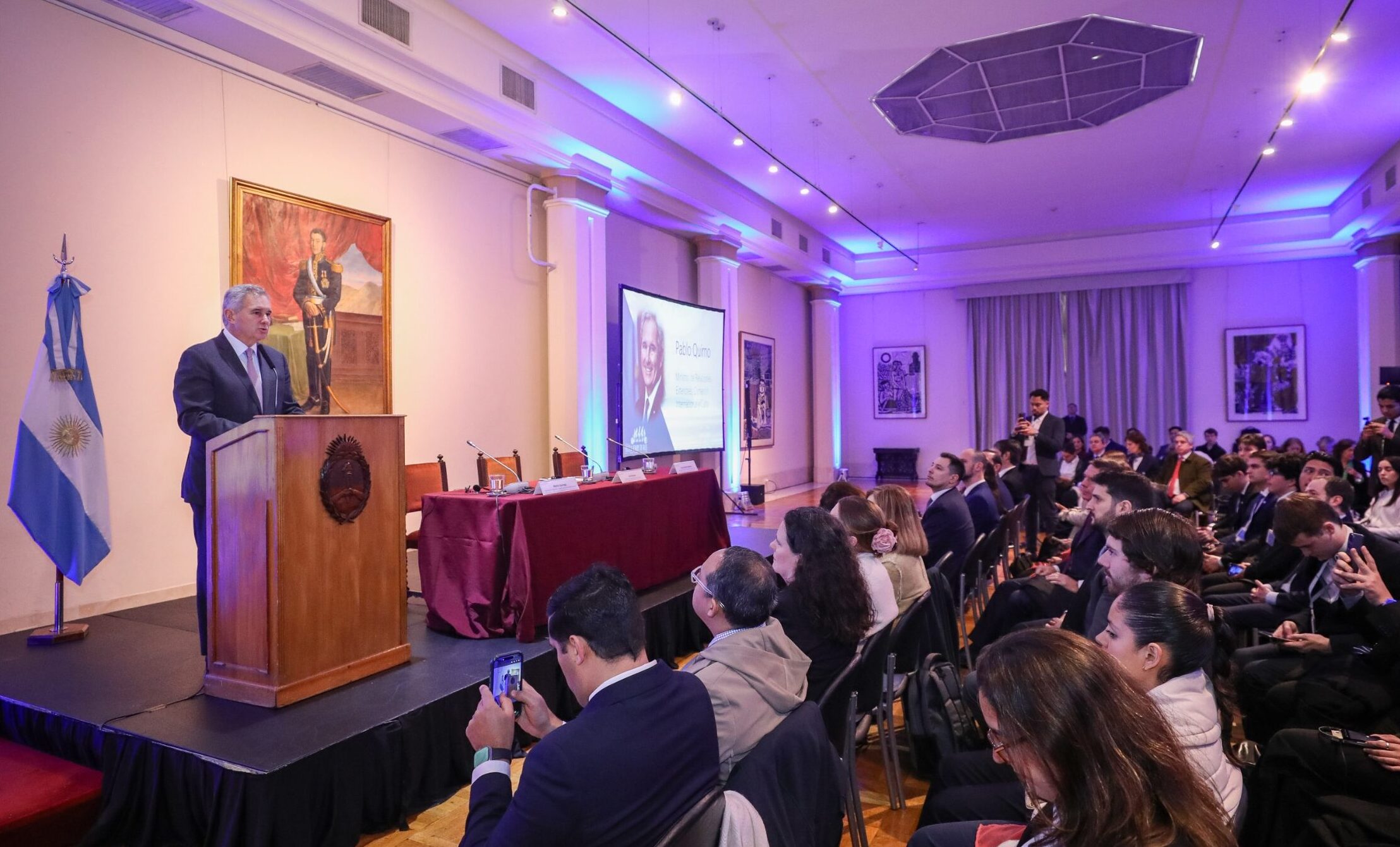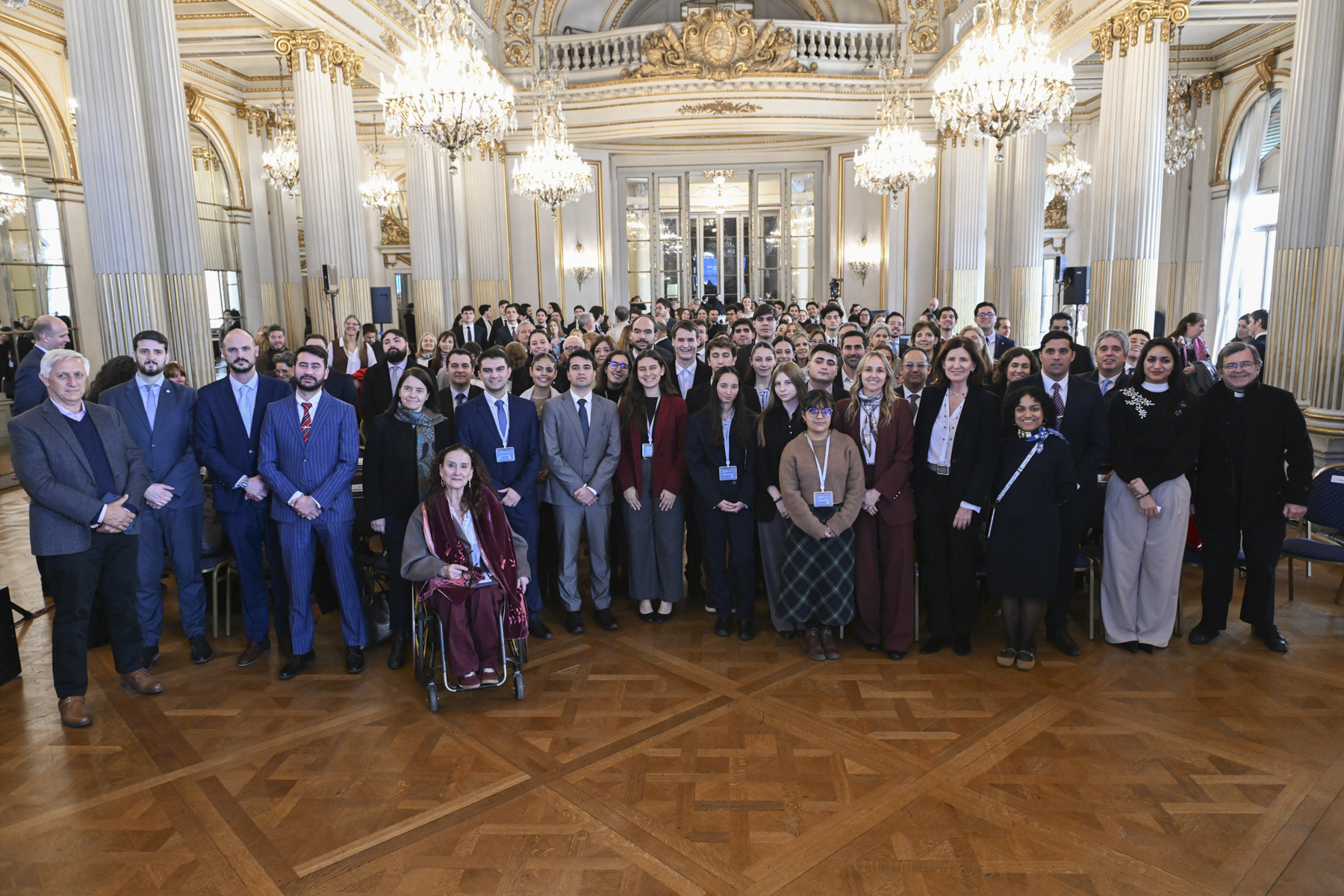
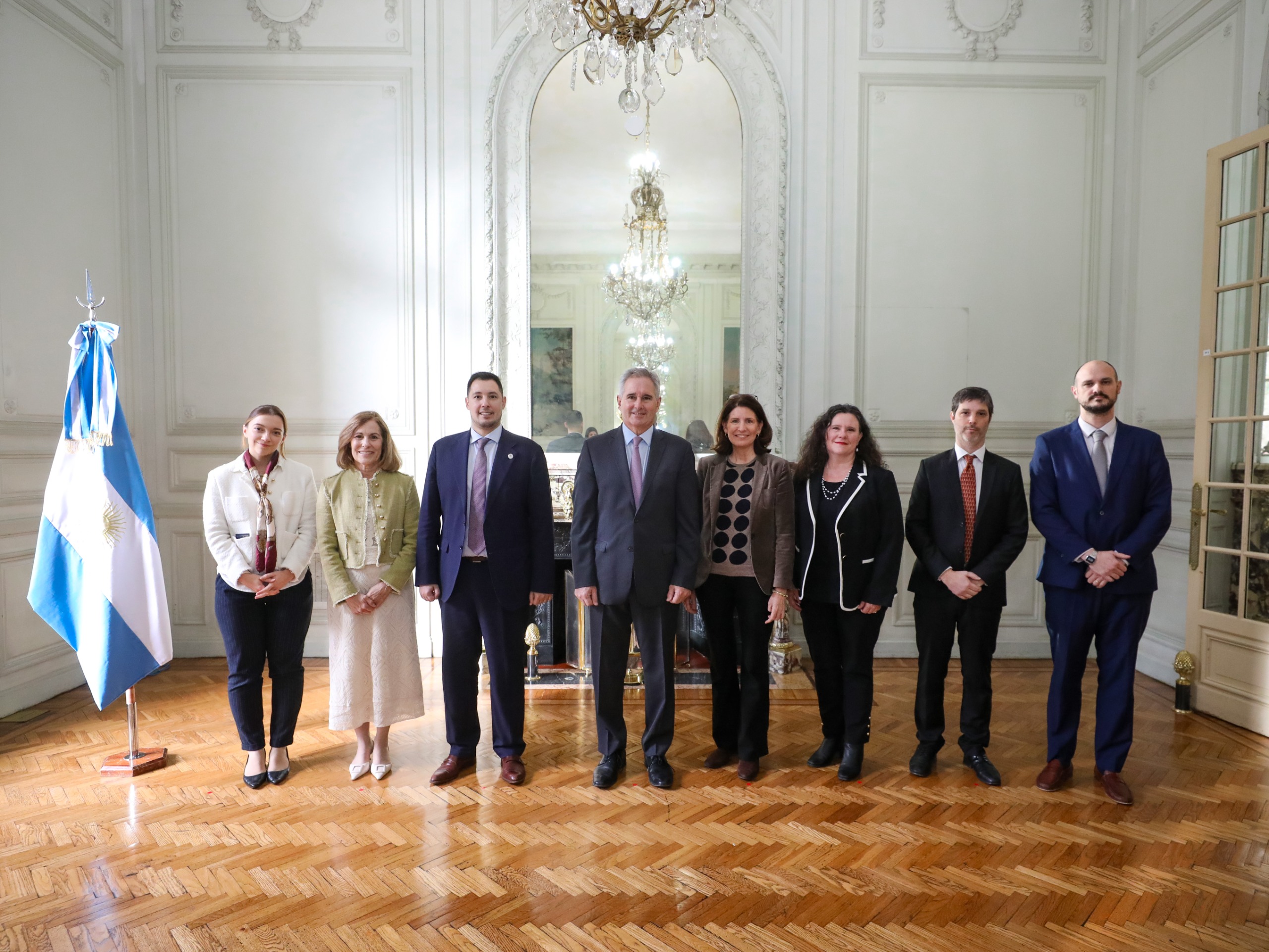
Buenos Aires | Foreign Minister Pablo Quirno set out natural rights as the moral compass of Argentine foreign policy in a in a landmark address delivered at the San Martín Palace on July 24, before an audience made up of members of the Executive and Legislative branches, civil society leaders, international figures, and young leaders from 15 countries.
The Foreign Minister delivered the keynote address at the Trialogue “Protecting the Future: Natural Rights at the Center of the International Agenda,” convened by the international platform Political Network for Values (PNfV), which also featured representatives from The Heritage Foundation, the Institute for Women’s Health, and the Global Center for Human Rights.
Quirno stated that foreign policy “is never neutral” and that every vote, negotiation, or alliance expresses a hierarchy of values. He said that Argentine diplomacy is once again speaking from its own identity, “rooted in the Western tradition and in our Judeo-Christian roots,” a “moral compass” that “promotes the protection of life from conception, recognizes the family as the natural and fundamental unit of society, and protects religious freedom and freedom of conscience.” He maintained that this agenda also values the dignity and decisive role of women in social life, defends the right to property, and upholds the sovereignty of states and the legal equality of all persons.
He affirmed that President Javier Milei placed these principles at the center of state priorities, in line with the Constitution and the mandate he received: “the rights that are born with the person order our domestic policy and project our voice in the world.” He said these principles are also the basis of his economic agenda, since a truly free economy does not produce wealth alone, but strengthens individual autonomy, consolidates families, and expands the spaces of freedom.
Truths capable of guiding the future
The Foreign Minister argued that international organizations lose authority when their bureaucracies try to turn “ideological preferences into universal obligations,” and that the crisis of the West began when societies stopped recognizing the permanent foundations of their freedom.
He explained that the Milei administration decided not to resign itself to that drift and adopted an active stance: “we believe that the strength of a democracy depends on the values on which it decides to build its institutions, and that international action gains greatness when it brings that truth to the meeting of nations. Argentina has chosen to occupy that place.”
For Quirno, defending natural rights is not about looking to the past, but about remembering that there are truths capable of guiding the future. It is not invoking a philosophical abstraction, but recognizing that the truth about the human person and those rights is not established by political power: it precedes it. For that reason, political power cannot modify them either; they are the limit that no authority may cross, and politics has the responsibility to protect them.
A new paradigm
Also taking part in the Trialogue was Agustín Caulo, Secretary of Worship and Civilization, who argued that affirming natural rights in multilateral discussions opens up a new paradigm, different from the trend that presents human rights as an arbitrary catalog of preferences dependent on ideological constructs or passing consensus.
“Human rights are only universal if there is an objective foundation that precedes them. The human person must never be a means at the service of power, but the ultimate end of all political action,” he said.
Santiago Santurio, a national deputy and Argentina’s representative on PNfV’s Advisory Board, said that more and more political leaders are convinced that “natural rights constitute the point of convergence and the most solid foundation for building an international agenda authentically oriented toward the service of the human person and the common good.”
An international perspective
The Trialogue also featured, as speakers, members of three organizations that are leading actors in the reshaping of the international landscape.
Valerie Huber, president of the Institute for Women’s Health and one of the architects of the Geneva Consensus Declaration, presented the development and influence of that international coalition, which now includes 41 nations. The Geneva Consensus helps member countries protect their sovereignty and maintain a common position in international forums on women’s health, the protection of life, and the strengthening of the family. For Huber, the generational momentum occurring across Ibero-America—of which Argentina is a leading player—will help consolidate this “civilizational alliance.”
The Global Center for Human Rights is an organization that works on behalf of natural rights within multilateral bodies such as the United Nations (UN) and the Organization of American States (OAS). María Quiroga, its Director of Research, presented a map of the extraordinary funding of the Inter-American Human Rights System and the external conditions that favor agendas which call its impartiality and independence into question.
The Heritage Foundation has been a key player in developing public policies to protect minors from gender indoctrination in schools, hormone therapies, and “sex change” procedures, as well as in restricting men’s participation in women’s sports competitions. Laura Bryant Hanford, a senior analyst at the think tank, presented some of the strategies implemented in the United States and a legislative proposal already underway in Ohio and Virginia.
Turning a shared vision into the capacity for action
The Trialogue brought together just over 100 members of Argentina’s Legislative and Executive branches at the national, provincial, and municipal levels; leaders of civil society organizations from the country; and international specialists. Young leaders from 15 countries also took part: Argentina, Bolivia, Brazil, Chile, Colombia, Ecuador, Spain, the United States, Guatemala, Mexico, Paraguay, Portugal, the Dominican Republic, Uruguay, and Venezuela.
“This gathering,” Quirno said in his speech, “brings together those who make laws, carry out policies, and build institutions. That convergence can transform shared convictions into an agenda that guides public life; it can turn a shared vision into the capacity for action. You can count on this Foreign Ministry and on my personal commitment to project a diplomacy at the service of life, freedom, property, and human dignity.”
The Trialogue was an initiative of PNfV, in partnership with Fundación Faro, Argéntea, Mises Cono Sur, Global Center for Human Rights, and Fundación Free.
The central theme of the event arose, according to Lola Velarde, PNfV’s executive director, from recognizing that we are going through a historical moment similar to the great transformations of the 16th century, when the School of Salamanca served as a beacon for Iberian rulers by recognizing and affirming, precisely in a complex moment, natural rights as the foundation of the social order.
*
The full speech by Foreign Minister Pablo Quirno is available here.