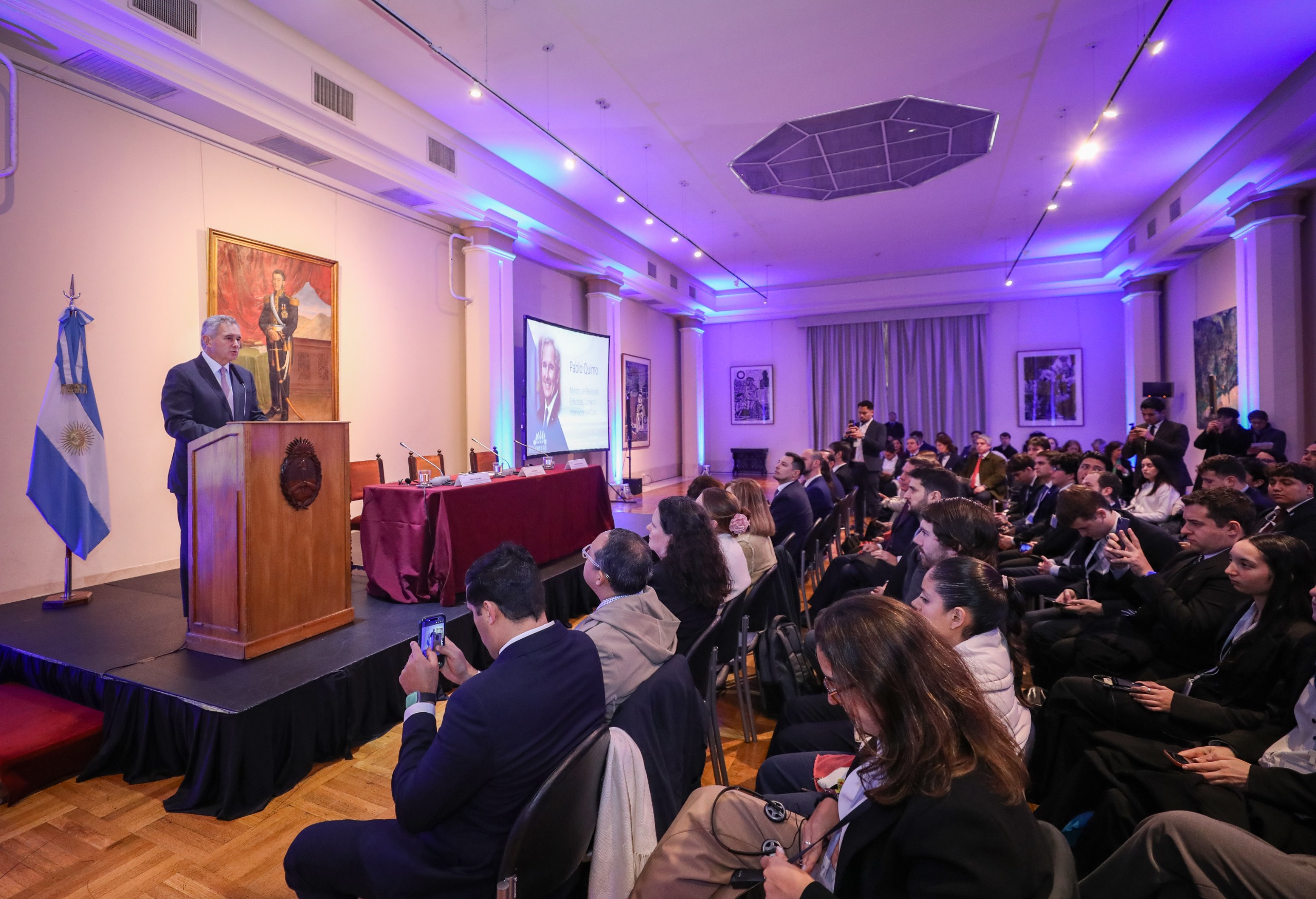
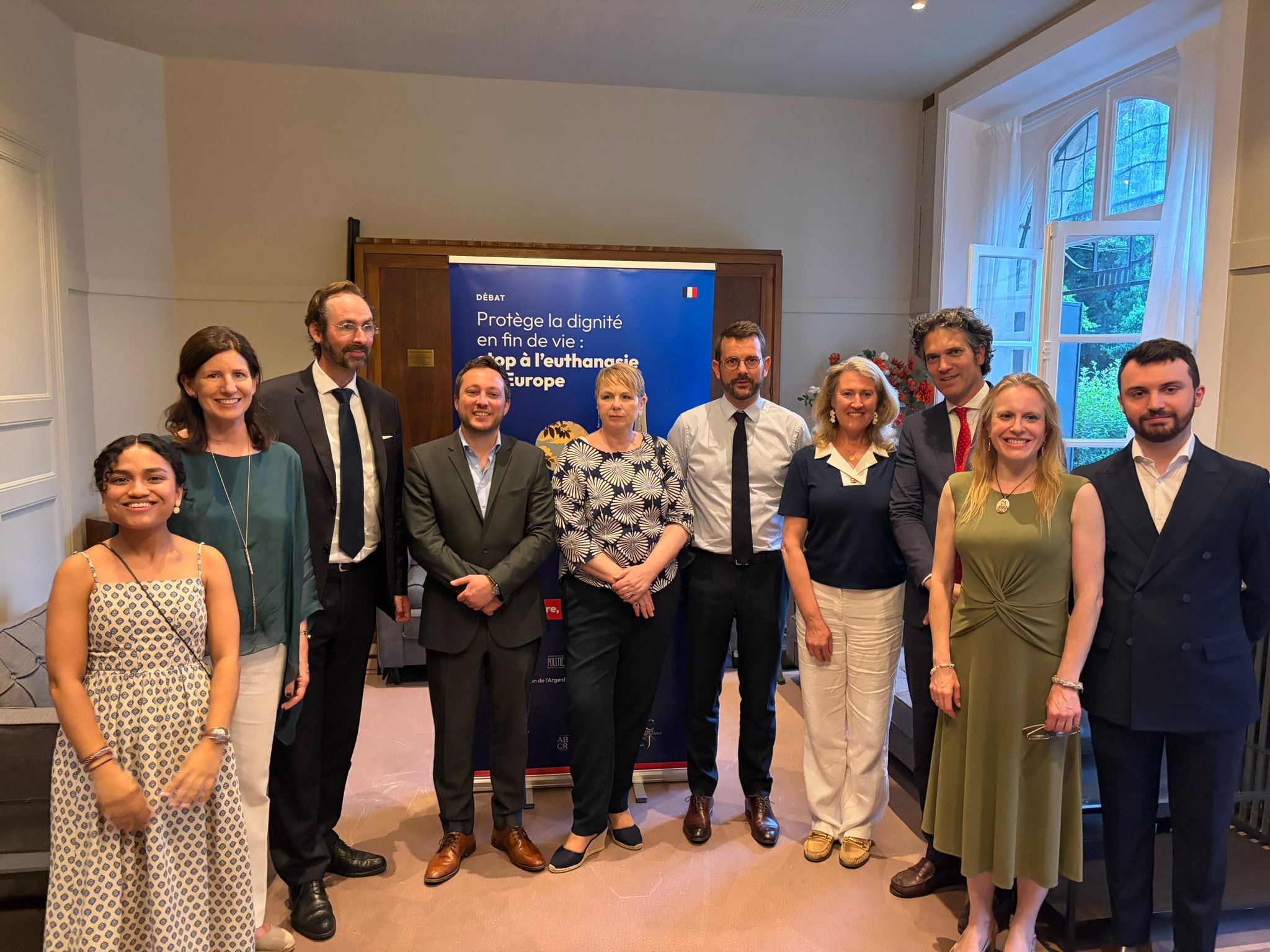
Paris | As France accelerates debate on a bill to legalize euthanasia, legislators, legal experts, and civic leaders from several countries gathered in Paris on May 28 to discuss the ethical, legal, and social implications of the expansion of euthanasia in Europe.
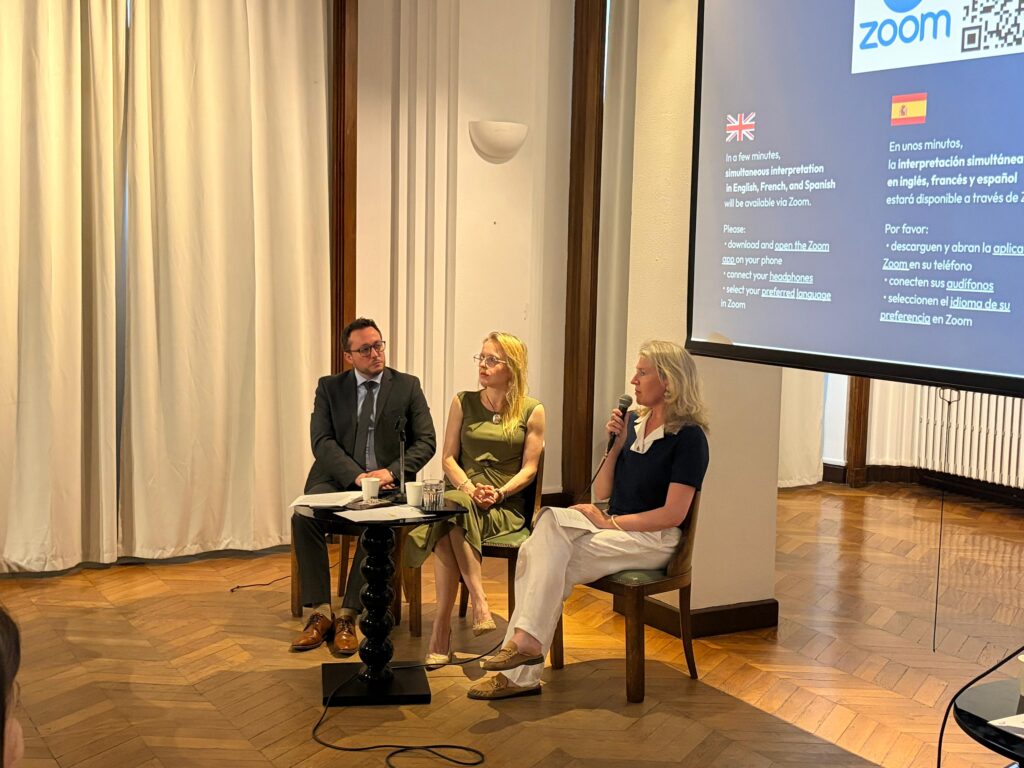
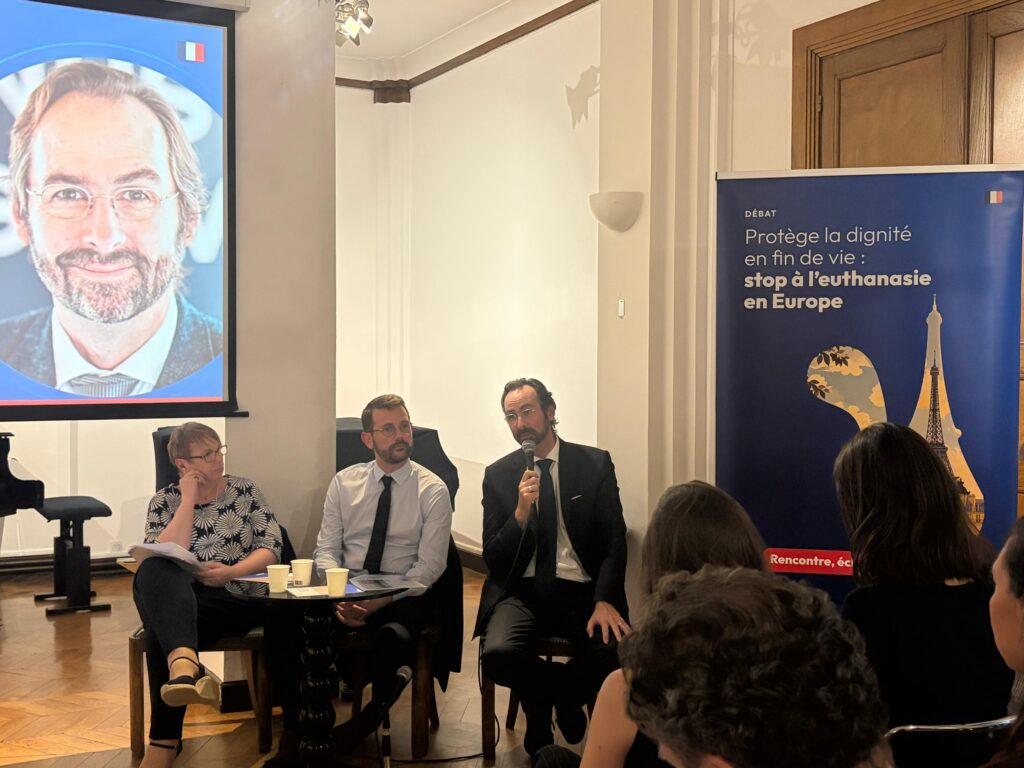
Participants in the conference, entitled “Protecting Dignity at the End of Life: Stop Euthanasia in Europe,” included Laurence Trochu, Member of the European Parliament; Christophe Bentz, Member of the French National Assembly; Grégor Puppinck, President of the European Centre for Law and Justice (ECLJ); Polonia Castellanos, President of the Spanish Foundation of Christian Lawyers (Fundación Española de Abogados Cristianos – FEAC); Amanda Hunter, Co-Founder of Families Against Involuntary Medical Euthanasia (FAIME), United Kingdom; and Lola Velarde, Executive Director of Political Network for Values (PNfV).
The event, held at the Argentine House in Paris and organized by PNfV, ECLJ, FEAC, and La Bourse Tocqueville, took place in a particularly sensitive context. French President Emmanuel Macron is promoting legislation under the label of “medical assistance in dying” to legalize euthanasia and assisted suicide. According to participants, the process is advancing at an unusually rapid pace and limits the possibility of a broad and thorough public debate.
You can watch a video summary of the event here.
The Noelia Case: The True Face of Euthanasia
Polonia Castellanos, President of FEAC, argued that the case of Noelia Castillo illustrates the true face of euthanasia. Noelia, a 25-year-old Spanish woman, received a lethal injection on March 26 following a process that, according to Castellanos, involved serious irregularities and failed to comply with Spanish law. Her last words were: “I am afraid.”
Castellanos explained that Noelia suffered from borderline personality disorder, obsessive-compulsive disorder, cognitive limitations, and physical injuries resulting from a suicide attempt following a gang rape. Despite the severity of her condition, she was reportedly making steady progress in her recovery and had regained the ability to walk short distances with the aid of a walker and crutches.
FEAC represented Noelia’s parents, who sought a court order to halt the procedure, arguing that their daughter was not capable of providing free and informed consent due to her psychiatric condition.
Castellanos further stated that the physician who proposed euthanasia to Noelia also served as an organ transplant coordinator and personally drafted the written request for euthanasia at a time when the young woman was psychologically vulnerable. She also noted that at least eight members of the review commission responsible for assessing the case had ties either to the organ transplant sector or to organizations advocating euthanasia.
“The Noelia case represents the failure of a system that was presented as having strong safeguards but, in practice, does not protect the most vulnerable,” she said.
Care, Not Kill
French Member of the European Parliament Laurence Trochu argued that a common mistake in contemporary debates is to equate human dignity with functional capacity, autonomy, or independence, while also granting the State the authority to determine who possesses dignity and who does not. She stressed that dignity is intrinsic to every human being and derives from human nature itself. It does not diminish because of illness, disability, suffering, or dependency. The State does not grant dignity; it recognizes and protects it.
For Trochu, the bill currently under discussion in France is particularly troubling because it presents euthanasia not as a narrowly defined exception but as a “right,” implying a profound transformation of the legal and cultural order. “The approval of this law would represent the defeat of solidarity; the answer to pain and suffering must be care, not killing,” she said.
Trochu also warned that certain expressions commonly used in public debate seek to obscure or soften the reality of what is being legalized: the deliberate intervention to end a patient’s life. She argued that euphemisms and emotionally appealing terms such as “death with dignity,” “aid in dying,” or “terminal bodily autonomy” can prevent a clear understanding of the ethical, legal, and social consequences of euthanasia. “The first step in confronting euthanasia is to use language correctly,” she said.
A Law Being Rushed Through
Christophe Bentz, a member of the French National Assembly, argued that Emmanuel Macron’s government is pushing euthanasia and assisted suicide legislation forward at an unusually rapid pace, reducing the time available for parliamentary and public debate because it knows the proposal is highly radical. The bill seeks to create a “right to assisted death,” which, in his view, represents an anthropological, social, and civilizational rupture.
Bentz recalled that European societies have historically built their healthcare and social protection systems on the principle of caring for and accompanying those who suffer. By contrast, the proposed legislation would formally incorporate the deliberate provision of death to patients as part of the legal framework, potentially affecting the poorest and most vulnerable members of society.
The bill has been approved twice by the National Assembly and rejected twice by the Senate, while a joint parliamentary committee tasked with reaching a compromise has failed to do so. If the legislation is not adopted within the current legislative calendar, it could be postponed. Bentz argued that the absence of consensus in Parliament should be sufficient reason to abandon the proposal. He also noted that, despite claims that the measure is supported by a large majority of French citizens, recent evidence suggests that euthanasia does not enjoy broad social consensus.
A Revealing Study
Laurence Trochu and Christophe Bentz cited a study published in January by the Fondation pour l’Innovation Politique (Fondapol), according to which 51% of French citizens oppose the legalization of euthanasia and assisted suicide, while 60% are unfamiliar with the contents of the bill currently under discussion. Opposition is found across all regions, from major cities to rural communities, and is strongest among young adults aged 18 to 24 (64%).
According to the same study, half of the French population believes that universal access to palliative care should be guaranteed before any “assisted dying” legislation is considered. If a close relative were seriously ill, 52% of respondents would prefer that he or she receive high-quality palliative care rather than euthanasia. This finding is especially significant given that, according to a 2025 report by France’s Court of Auditors (Cour des Comptes), half of those who require palliative care in the country do not currently have access to it.
The Most Vulnerable at Risk
Amanda Hunter, Co-Founder of Families Against Involuntary Medical Euthanasia (FAIME), noted that there is no social or parliamentary consensus in the United Kingdom regarding euthanasia either. A bill introduced in the British Parliament in 2024, which initially appeared likely to advance, failed on April 24, 2026, after running out of parliamentary time. Hunter credited the efforts of associations, healthcare professionals, and families for slowing the process and increasing public scrutiny.
Although some MPs have promised to reintroduce the proposal in a different form, Hunter questioned the claim that there is strong public demand for assisted suicide. By contrast, she argued, there is significant demand for better palliative care. One in three people who die in England do so without receiving even basic palliative care services.
Hunter also recounted her own family’s experience, arguing that current end-of-life practices can sometimes accelerate death through the withdrawal of food and hydration, as she said happened to her father. She warned that once a society accepts intentionally caused death as a legitimate response to suffering, doctors, institutions, and governments may begin to view cost reduction as a significant factor in decision-making. Those most at risk, she argued, are the vulnerable, particularly those without financial resources or strong family support.
A Civilizational Question
Grégor Puppinck, President of the European Centre for Law and Justice, argued that much of the current debate reflects a view of the human person grounded in absolute individual autonomy. In contrast, he defended an understanding of society based on vulnerability, interdependence, and mutual responsibility.
Puppinck maintained that caring for the weak and vulnerable is one of the historic foundations of European civilization. In his view, euthanasia laws do more than alter medical procedures; they gradually transform society’s understanding of illness, dependency, suffering, solidarity, and death itself.
He concluded by warning that the debate extends far beyond healthcare and raises fundamental questions about human rights, the limits of public authority, and the kind of society Europe wishes to build for future generations. “The legalization of euthanasia represents a civilizational regression,” he said.
“More and More People Are Joining Us”
Santiago Muzio, Director of the Argentine House in Paris and host of the event, stated that the defense of life is a cause that continues to attract growing support. He described life as a gift from God and argued that death should never be offered as a response to suffering. Instead, society should care for and accompany people so that, when their Creator wills it, they may breathe their last breath with dignity.
“This is very important to us. These are not just words. That is why we opened the doors of the Argentine House. The defense of life from conception to natural death is part of the values of our people, and the current government embraces it as one of its guiding political principles,” he said.
Closing the event, Lola Velarde, Executive Director of Political Network for Values, called for building a culture in which responding to suffering by eliminating the sufferer becomes unthinkable. She argued that more and more people are raising their voices in defense of life and questioning the direction taken by some European legislations.
Velarde presented a roadmap for caring for people and defending their dignity at the end of life. “It is always possible to take a step forward in affirming life as a gift that the State must protect. The advance of euthanasia is not unstoppable. More and more people understand that the answer to suffering is to care, accompany, and not discard,” she said.
You can watch the full recording of the event here.